Mystery coloring, 5 beginner mistakes to avoid to truly relax
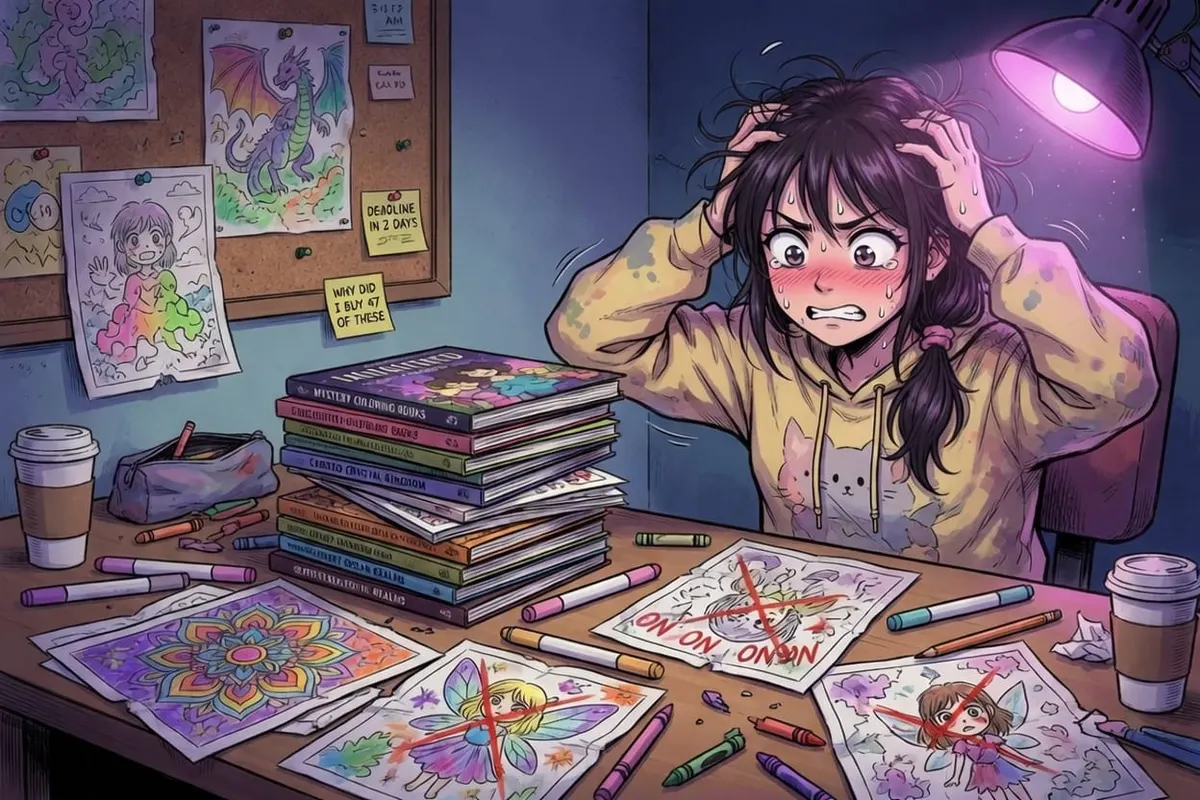
When you're starting out with mystery coloring books, the enthusiasm of the early days often pushes you to make choices you'll regret later. Instead of a relaxing activity, it becomes a frustrating chore, you pile up unused supplies, and you give up before even finishing a single drawing. The good news is that all these mistakes are avoidable. In this article, I list the 5 classic traps I see beginners falling into time and time again, and for each one I give you the concrete solution to avoid it.
Mistake 1: Choosing a design without looking at the final result
This is probably the number one mistake and the one that kills most of the joy of coloring. Many beginners think that looking at the solution before starting "spoils" the experience. In reality, it's the opposite: if you start a drawing without knowing what you'll discover, you risk spending 5 hours on a subject you don't like at all. And then frustration is guaranteed.
Typical example: you open a Disney book at random, you start coloring without looking, and after 3 hours you realize it's Winnie the Pooh, a character you don't like. You don't want to finish, the result disappoints you, and you close the book telling yourself "coloring isn't for me".
The solution: ALWAYS look at the solution pages at the back of the book before starting a drawing. Ask yourself honestly: "Do I want to have this drawing finished in front of me?" If the answer is "meh" or "no", pick another one. The coloring market is huge, you'll always find a drawing that truly speaks to you.
Mistake 2: Buying too much material at once before knowing your style
On YouTube or Instagram, you see pro colorists with boxes of 168 Copic markers, 120-color Polychromos palettes, sophisticated layouts. You tell yourself "I need all that to do the same". And you drop 300 € in one weekend only to discover that you use 15 colors out of 168, and that alcohol markers bleed through your book pages.
Typical example: you buy a big box of premium alcohol markers for 200 €. You start a double-sided book. On the first page, you bleed through and ruin the back. You get sick of the material, you don't dare use it anymore, and it gathers dust in a drawer.
The solution: start with a minimalist mid-range kit and see where you stand after 5 or 10 colorings. You'll then know:
- What type of material suits you best (alcohol markers, acrylic, pencils)
- Which colors you use the most
- Whether you prefer large or small formats
- Whether you color fast or in contemplation mode
To get started, a set of 24 to 36 Faber-Castell Black Edition pencils or a pack of Tooli Art markers is more than enough. You'll upgrade later, with full knowledge of what you actually need.
Mistake 3: Jumping straight on an Expert level book
On Amazon, you see a gorgeous Disney mystery coloring book Expert level, with 60 ultra detailed designs and stunning gradients on the cover. You buy it. You get home, open the book, and face a drawing with 800 different zones and 45 color shades to manage. After one hour, you've colored only 5 % of the drawing and you're already exhausted.
Typical example: an Expert level drawing often takes 8 to 15 hours to finish. If you're a beginner, that's the opposite of what you need. You'll give up halfway, tell yourself you're not cut out for this, and the book will gather dust.
The solution: start with Beginner or Intermediate level books. You'll finish your drawings in 2 to 4 hours, which gives you that completion sensation that motivates you to keep going. You build your enjoyment progressively. After 10 or 15 Beginner drawings, you can move on to Intermediate, then Expert, without frustration. Publishers like Hachette Heroes clearly indicate the level on the cover, it's easy to spot.
Mistake 4: Not finishing a started zone (losing the color code)
This one is very specific to color-by-number mystery coloring. You start coloring a large single zone in "I'll just do 5 minutes and come back tomorrow" mode. Bad idea. Why? Because as you color, you cover the color code printed in the zone. And the next day, you pick up the half-finished zone, you can't see the code anymore, and you use another shade by mistake.
Typical example: you color half of a large zone in light brown (color n°12), you take a 2-day break. You come back. You see "brown" but you can't remember if it was n°11, 12 or 13. You grab the 13. Result: the zone has two different shades and it shows in the final result.
The solution: two options that work well:
- Finish each started zone before putting down your pencil. Never half-finished zones again. If you don't have time to finish a large zone, pick a smaller one instead.
- Note the color number on the border before starting. With a light pencil mark, write "12" in a discreet corner of the zone (which will be covered by the color later). That way, when you come back, you see your note.
Mistake 5: Forcing yourself when you're no longer in the flow
Coloring is supposed to relax you. If you force yourself to keep going when you don't feel like it anymore, when you're out of patience, or when you're tired, the effect is exactly the opposite: you end up tense, frustrated, and you end up associating coloring with a chore. It's the most subtle mistake because you can spend weeks doing it without realizing.
Typical example: you set yourself the challenge of finishing your drawing by the end of the week. Wednesday evening, you're exhausted. But you keep going, because "I said I'd finish it". You make 3 color mistakes, your line is shaky, you resent your drawing. The next day, you don't want to touch it anymore.
The solution: listen to your body and your mind. If the session is no longer pleasant, stop. Put down the pencil, take a break for a few hours or a few days. The coloring will wait, it's not going anywhere. Come back when you feel like it, not when you "have the time". Your joy is more important than your speed of completion. And that's exactly the philosophy that makes coloring a real anti-stress and mindfulness tool, not just another task on your to-do list.
My global advice to start serenely
If you remember nothing else from this article, remember this: you color to feel good, not to perform. All the mistakes above share one thing in common: they turn a relaxation activity into a stress source. So before each session, ask yourself: "Am I forcing myself or am I treating myself?". The answer will tell you whether you're in the right mindset or whether you should adjust something (the drawing, the material, the moment, the duration).
Frequently asked questions
What's the right age to start mystery coloring?
Publishers release books suitable from age 6 or 7, with simple color codes (10 to 15 colors maximum, large zones). For adult beginners, "Easy" level books are perfect, regardless of your age. You can discover my free printable pixel mystery colorings to test without investing.
How long does it take on average to finish a mystery coloring?
It all depends on the book level and the drawing format. Generally: 1 to 2 hours for a Beginner drawing, 3 to 5 hours for Intermediate, 6 to 12 hours for Expert. Plan for several 30 to 60 minute sessions rather than a single marathon: the joy lasts longer and the result is better.
Can you frame a finished coloring?
Of course, it's even recommended for the most beautiful ones. Scan the drawing with a free mobile app (like Adobe Scan), print it on A4 thick photo paper (200 g/m² at least), and slip it into a standard frame. You'll have a unique decoration item handmade by you. You can also simply detach the page if the book has spiral binding, and frame it directly.
What if I don't like my finished result?
It happens, and it's normal. You can either redo the drawing with different color choices (the solution pages are there for that), or consider it a learning step and move on to the next one. Over time, you'll get better at anticipating the result and your choices will align more with what you love. It's a skill that develops with each drawing.
For further reading
If this article spoke to you, you can also check out my other resources to start strong:
- My detailed comparison of alcohol vs acrylic markers to choose the right type of marker for your book
- My material reviews: Tooli Art, Nicety, Faber-Castell Black Edition and Polychromos
- My book reviews to choose your first purchase wisely
- The PixelSecret coloring gallery to color directly online without buying anything
Conclusion
The 5 mistakes we just covered are not inevitable. They're just the result of a too enthusiastic or too ambitious start. If you take the time to choose the right drawing, the right materials, the right level, and you respect your own rhythm, you'll discover why millions of people made coloring their #1 relaxation tool. Move forward step by step, celebrate each small victory, and always keep in mind that your joy is the goal.
Happy coloring, and feel free to share your finished pieces when you complete a drawing that means a lot to you.
The visuals (illustrations, excerpts, photos) shown on this page are used for illustration purposes and remain the property of their respective authors/publishers. Trademarks and names belong to their respective owners. Colorings and photos are by Usako unless stated otherwise. Any reproduction, distribution, or commercial reuse is not allowed without the prior consent of the rights holders.