Alcohol markers vs acrylic markers: which one for your mystery coloring books?
When you're starting out with mystery coloring books, you quickly run into the question that divides the whole community: alcohol or acrylic? Both types of markers have their fans, their advantages, and most importantly their own rules of use. Picking the wrong one can lead you to bleed through a page that took you 5 hours to color (yes, it happened to me). In this article, I break down the two families of markers, I tell you which ones I use daily, and I give you my method to choose depending on the book in your hands.
What is an alcohol marker?
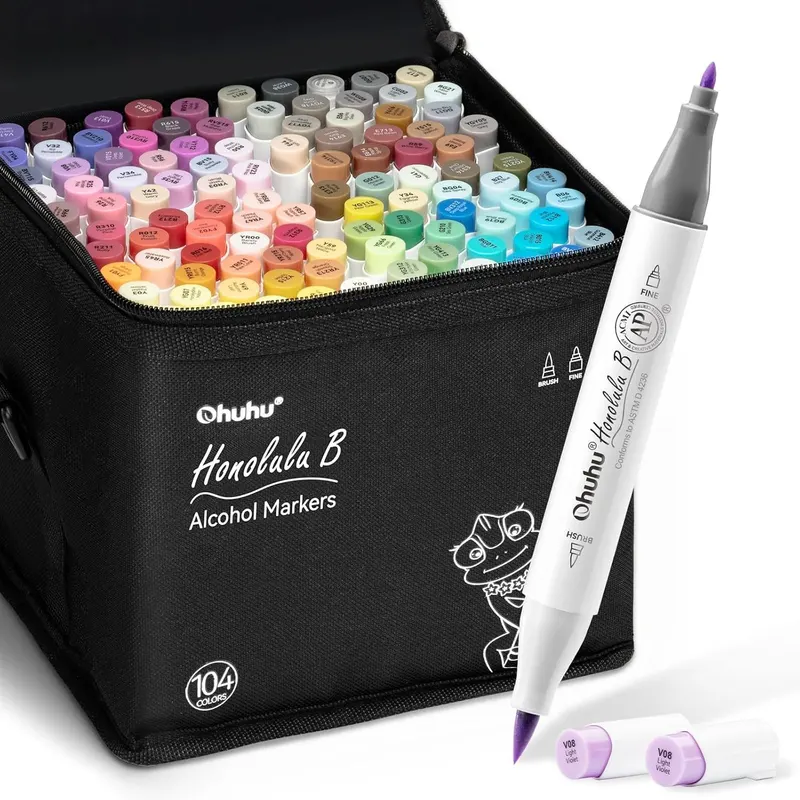
An alcohol marker is a marker whose ink is diluted in alcohol (usually isopropyl alcohol). The ink penetrates deep into the paper and dries very quickly through evaporation. These are the favorite markers of illustrators, manga artists, and architects for their smooth finish and their ability to blend with each other to create seamless gradients.
On the brands side, there's something for every budget:
- Copic: the Rolls-Royce of alcohol markers, but expensive (5 to 8 € per marker individually)
- Ohuhu: excellent value for money, my daily pick (Honolulu, Hawaii series, etc.). My full review of the Honolulu B 320 set
- Promarker: a great classic, mid-range
- Touchnew, Caliart, BIANYO: decent entry-level options for beginners
Alcohol markers almost always have two tips: a fine one (for details) and a wide chisel or brush tip (for large areas).
What is an acrylic marker?
Acrylic markers work in a completely different way. Their ink is water-based with acrylic pigments in suspension. Instead of penetrating the paper, the acrylic dries on the surface, forming a thin opaque matte layer. This is what makes its biggest strength: it never bleeds through paper, even thin paper.
A small technical detail: before each use, you have to shake acrylic markers to mix the pigments with the liquid base. Otherwise you get a pale or uneven finish.
Popular brands:
- Posca: the absolute reference, present in every art school
- Tooli Art: my value pick for coloring
- Nicety: another option I tested and that works really well
- Arrtx, Edding: interesting alternatives
Quick comparison overview
- Finish: alcohol = very smooth and glossy. Acrylic = matte and opaque.
- Gradients: alcohol = easy and seamless. Acrylic = harder (surface drying too fast).
- Bleeding through paper: alcohol = yes, almost always. Acrylic = almost never.
- Drying time: alcohol = ultra fast (a few seconds). Acrylic = fast too but visible for a few minutes.
- Blending between colors: alcohol = yes, that's the whole point. Acrylic = no, each layer stays independent.
- Fixing mistakes: alcohol = impossible. Acrylic = yes, you can go over it.
- Average price: alcohol = 0.80 € to 8 € depending on brand. Acrylic = 1.50 € to 5 € depending on brand.
- Long-term durability: both resist light well, but acrylics are more stable long-term.
What paper for what marker?
This is THE critical question for mystery coloring books. The finish of your markers depends as much on the marker as on the paper you use. Here's the practical rule I apply:
For alcohol markers
Alcohol markers bleed through almost any paper. So:
- One-sided printing books (Coco Wyo, some Hachette Heroes mystery Disney): you can use your alcohol markers. No risk of ruining a back design since there isn't one. I still recommend slipping a layout paper sheet between pages to protect the next pages.
- Double-sided book (front and back printing): forbidden. You'll bleed through and ruin the design on the other side. Avoid unless you're willing to only use one page out of two.
The paper I use as protection: Schoellershammer Layout Block Special Alcohol Markers 75 g/m², A4 format, semi-transparent. For 75 sheets it's very affordable and it protects you even from the most pigmented markers. I systematically slip it behind the page I'm coloring.
For acrylic markers
Acrylic markers work everywhere. One-sided, double-sided, thin paper, premium paper: do whatever you want. No risk of bleed-through since the ink dries on the surface. That's their major advantage over alcohol markers.
My personal experience (and my fail)
Let me tell you the disaster that taught me the lesson. The first time I pulled out my Ohuhu markers, I fell in love: the finish is gorgeous, the colors are vibrant, the gradients are easy. I jumped straight on a Disney mystery coloring, a design with Jasmine and her tiger Rajah. For 3 hours, pure joy.
Except the book was double-sided and I didn't know that alcohol markers bleed through. When I flipped the page, the design on the back was completely ruined. All the areas I had colored with alcohol marker on the previous page had bled through into more or less defined stains. I was devastated.
The trick I learned after this fail: if you find yourself in the same situation, color the back design with acrylic markers. The opacity of acrylic will completely cover the alcohol stains and you can save the design. With regular water-based markers, it doesn't work (they mix with the alcohol and give you a muddy color). And with colored pencils, the coverage isn't strong enough to hide the stains. So acrylic = your savior in case of disaster.
I have since redone the test properly and photographed the front and the back of the same page, so you can see exactly what happens before you buy: my full review of the Ohuhu Honolulu B 320.
Practical tips for alcohol markers
A few techniques I use to get the best out of my Ohuhu and Promarker:
- Always start with the lightest colors. Then go over with darker and darker shades to create a seamless gradient. If you start with dark, you can't go lighter.
- Work in small areas. Alcohol dries fast, so if you want to blend two colors, apply them while they're still wet.
- Finish with a light colored pencil touch to add nuance and highlights. A colored pencil applied lightly over dry alcohol gives a beautiful finish.
- Always protect the next page with a layout paper sheet (Schoellershammer mentioned above).
- Store your markers flat (horizontally). Alcohol markers keep better lying down (and it lets you see your colors at a glance).
Practical tips for acrylic markers
- Shake the marker before each session. Pigments settle at the bottom, you need to remix them. Otherwise you get a pale finish.
- Prime the tip on scrap paper before coloring to get the ink flowing.
- Work in two layers if the first one looks a bit transparent. With acrylic, you can go over without trouble, layers stack cleanly.
- Save fine details for last. Once the acrylic layer is dry, you can add black lines or details on top without mixing.
- No need for protective paper. Acrylic doesn't bleed through, so you can color directly.
When to choose alcohol? When to choose acrylic?
Here's my quick decision rule, valid for most cases:
- One-sided book + you love smooth glossy gradients ? alcohol markers (with protection sheet).
- Double-sided book ? acrylic markers, no question.
- You're a beginner and don't want to stress ? acrylic markers. More forgiving, easier to use, no waste risk.
- You want the most pro finish possible ? alcohol markers, investing in a good brand (Ohuhu, Promarker, Copic if budget).
- You mostly color large solid areas (pixel art, color by numbers) ? acrylic, the matte finish is perfect for it.
- You mostly color designs with lots of small details and gradients (mandalas, detailed illustrations) ? alcohol.
My material recommendations
If you're going for acrylic markers
- Tooli Art: my first value-for-money pick. Wide palette, clean finish, can dry within a day. My full review of the Tooli Art markers.
- Nicety: another reliable option, slightly different texture-wise. My hands-on review of the Nicety markers.
If you're going for colored pencils (an alternative to markers)
Colored pencils are an excellent alternative to both marker types, especially if you want a soft controlled finish without any bleed-through risk.
- Faber-Castell Black Edition (budget): excellent entry-level. My review of the Faber-Castell Black Edition.
- Faber-Castell Polychromos (premium): my favorites for detailed mystery colorings. My detailed review of the Polychromos.
Frequently asked questions
Can I mix alcohol and acrylic markers on the same drawing?
Yes, but with a golden rule: always start with alcohol, finish with acrylic. Acrylic covers alcohol without trouble, but if you do it the other way around (acrylic first then alcohol on top), the alcohol will dissolve the acrylic layer and create a muddy mix. This is also the technique to save a drawing where you bled through: cover with acrylic.
How do I prevent my alcohol markers from drying out?
Store alcohol markers flat (horizontally) rather than upright. The alcohol stays evenly distributed in the reservoir. Keep them in a dry spot, away from direct sun, at room temperature. If you see the tip getting dry, you can revive it by pressing it firmly on scrap paper or briefly dipping it in isopropyl alcohol.
Do acrylic markers stain clothes?
Yes, and it's hard to remove once dry. Acrylic dries by forming a waterproof layer. If you stain something, wash immediately with cold water before it dries. Once dry, you need a specific solvent (white-spirit, acetone) which can damage the fabric. My tip: wear an old t-shirt or an apron when you color with acrylic markers.
Do I need special paper for acrylic markers?
No, any paper will do. That's actually the big advantage of acrylic: it holds on anything, including low-quality paper, cardstock, canvas, wood, metal, glass. For mystery coloring books, the standard book paper is more than enough.
How much should I spend to get started?
To start with acrylic markers, expect 30 to 50 € for a 30 to 60 color palette (Tooli Art or Nicety). To start with mid-range alcohol markers, expect 40 to 80 € for a 40 to 80 color palette (Ohuhu or Touchnew). Don't buy the 168-color Copic boxes at 1000 € when you're starting out, it's money thrown out the window until you've found your style.
Conclusion
Alcohol markers and acrylic markers aren't competitors, they're complementary. The right choice depends on the book in your hands and the finish you're looking for. If I had to sum it up in one sentence: acrylic for versatility and safety, alcohol for pro finish and gradients. And if you can, keep both in your kit to be able to adapt to each coloring book.
If you want to try a free coloring before investing in materials, you can download a free printable pixel mystery coloring or color directly online in the PixelSecret gallery.
The visuals (illustrations, excerpts, photos) shown on this page are used for illustration purposes and remain the property of their respective authors/publishers. Trademarks and names belong to their respective owners. Colorings and photos are by Usako unless stated otherwise. Any reproduction, distribution, or commercial reuse is not allowed without the prior consent of the rights holders.