GuangNa : 168 colors for 69 dollars, and a review I had to rewrite
🛟️ Curious about this item?
I’ve reviewed it below, but if you already want to see it on Amazon:
 👉 View on Amazon
As an Amazon Associate I earn from qualifying purchases. This does not change the price you pay.
168 colors for 69 dollars, and a review I had to rewrite
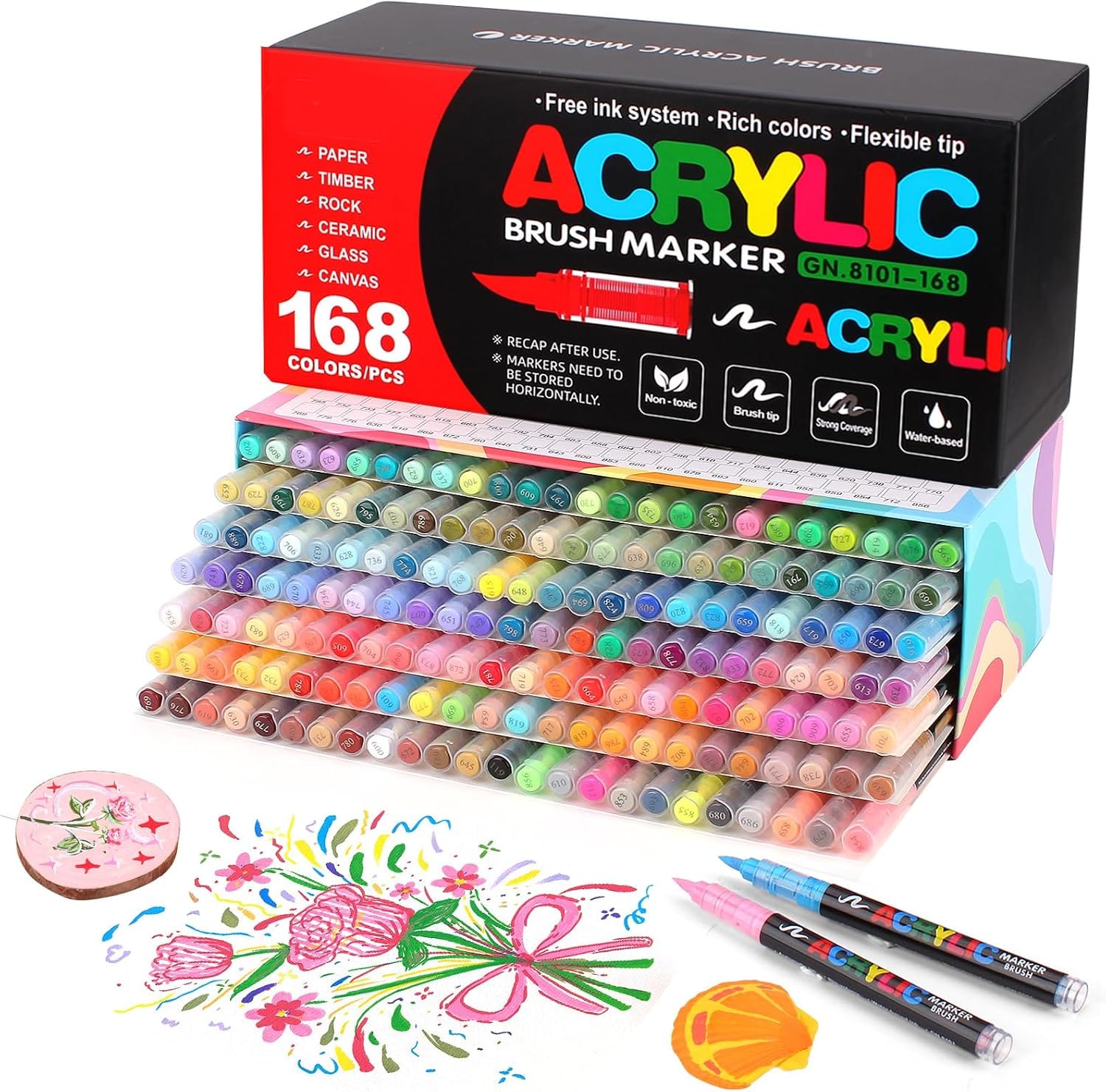
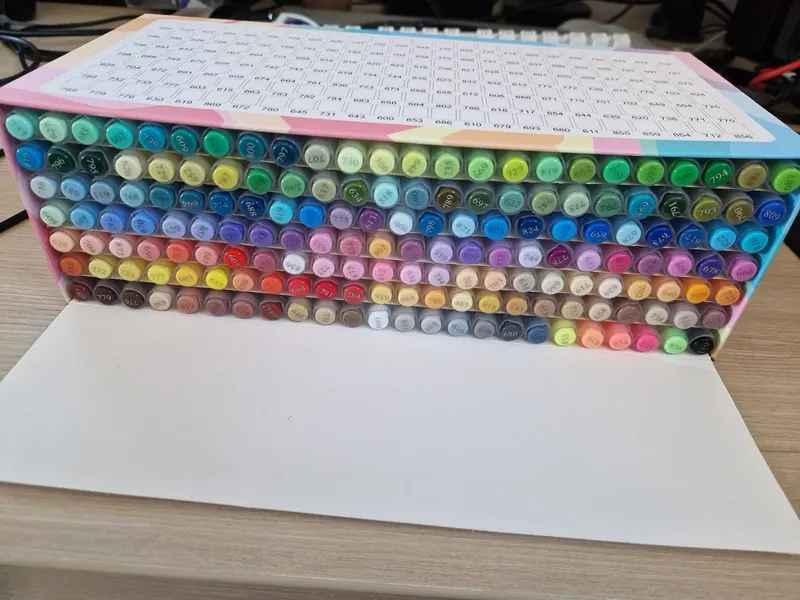
I bought this set in February 2025 and it sat in its box for quite a while. What drew me in was the number of shades for the price. I paid 65.99 euros for mine in France, and the 168 color set sits around 68.99 dollars on Amazon, which works out at roughly 41 cents per marker, when a branded set of acrylic markers easily costs three times that.
What held me back was the tip. A brush tip. And I had a very bad memory of those.
I was wrong, and I would rather say so
In my comparison of six brands of acrylic markers, I wrote it in black and white: stay away from brush tips if you color inside closed areas, it is not the right tool, whatever the brand.
That sentence came from my experience with the Arrtx. Their brush tip really is too soft. It flattens at the slightest pressure, you control nothing, and in a small cell you go over the line every other time. I turned that into a general rule.
So when I took the GuangNa out at the end of August, I came in with a prejudice. My exact words on 29 August: "everyone is using GuangNa at the moment, I do not really like them, brush tip markers". After a first try on scrap paper I softened it: "actually they are not bad, it is just me, it is like eyeliner, brushes, I am not good at it".
And the next day, after actually starting a coloring page, I wrote this: "Honestly? I was wrong. Compared with the Arrtx they are great. The brush tip is soft but firm. You can do corners and small areas easily. I love them."
My comparison was not wrong about the Arrtx. It was wrong to generalize. Not all brush tips are equal, and the difference comes down to one thing: firmness.
The specs
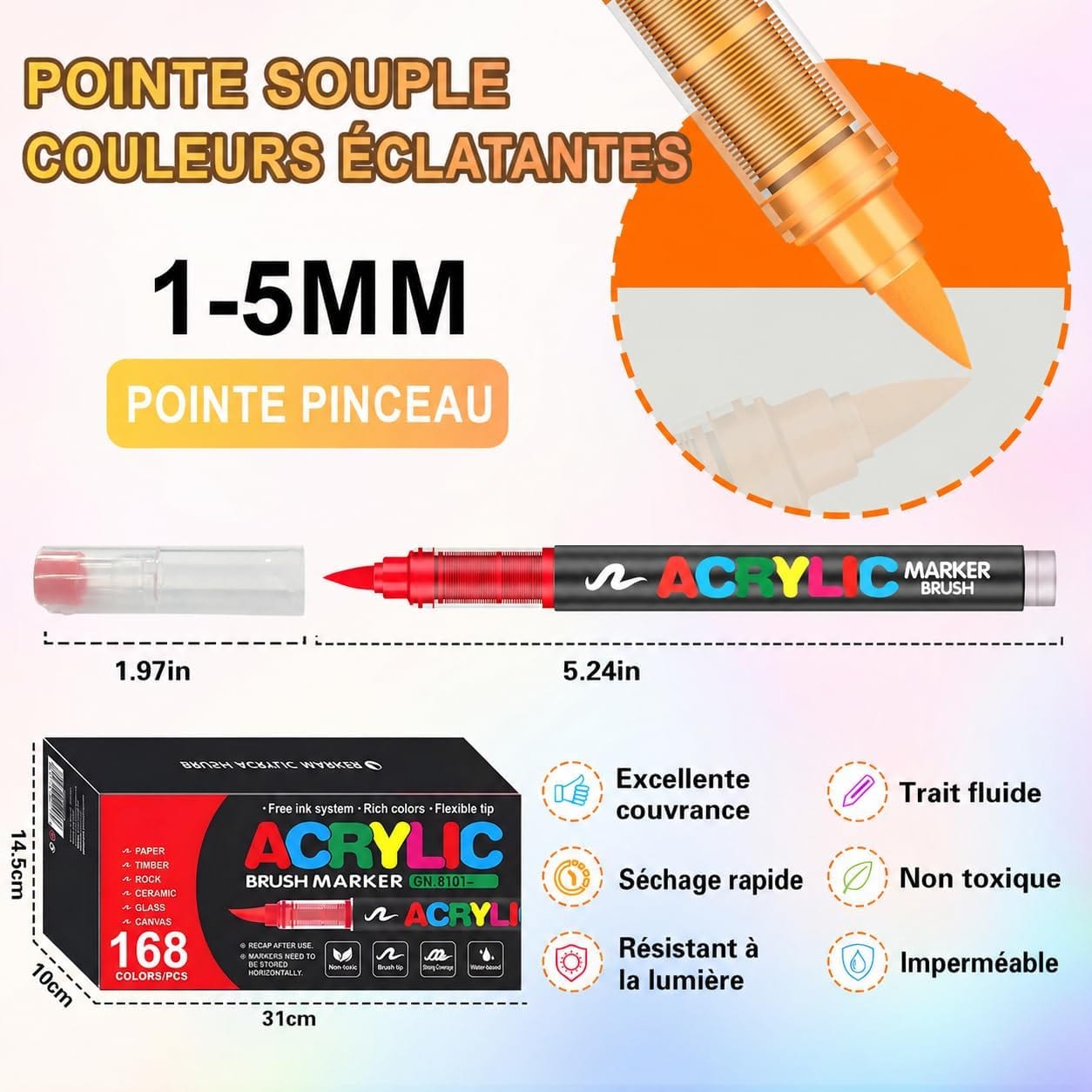
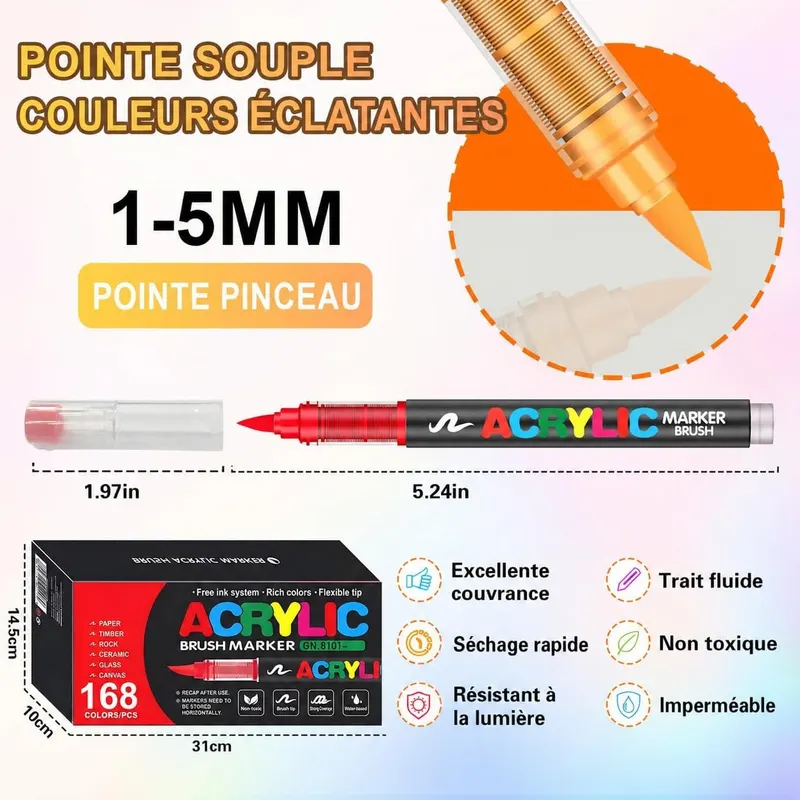
Exact name: GuangNa Acrylic Brush Marker, reference GN.8101-168
Type: water-based acrylic markers, valve system
Tip: flexible brush, 0.1 to 0.5 mm
Surfaces listed: paper, wood, stone, ceramic, glass, canvas
My set: 168 colors, bought in February 2025, 65.99 euros in France and about 68.99 dollars on Amazon
Full range: from 24 up to 360 colors, with the 360 set at around 149.99 dollars
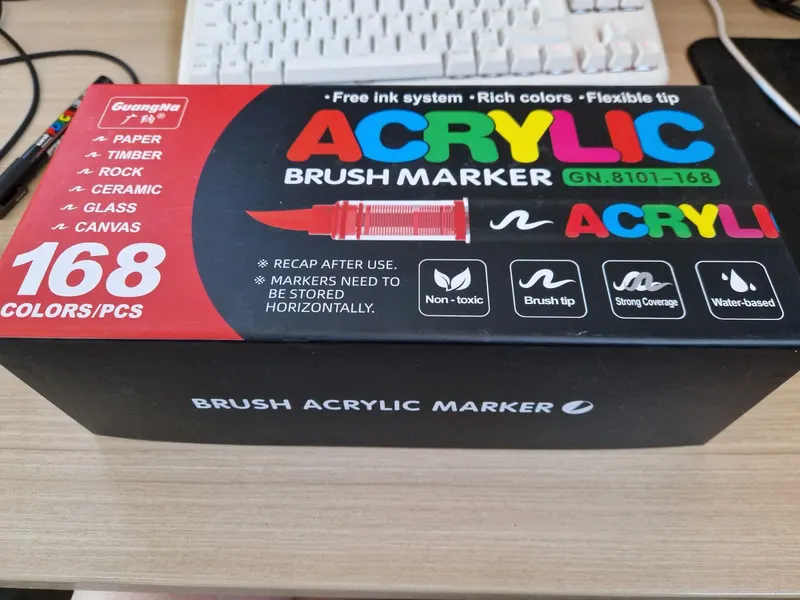
One detail that looks trivial and is not: the box says the markers must be stored horizontally. On a valve system, that is not decorative advice. Stored upright, the pigment settles to one side and the tip loads badly. I mention it because it is printed in tiny letters on the lid, and nobody reads the lid.
Second detail, and this one had me going in circles: the name changes depending on where you look. The box says GuangNa, the Amazon US listing says Guangna, and the French listing calls them Gunsamg. Same reference GN.8101-168, same product, three spellings.
The tip, soft but firm
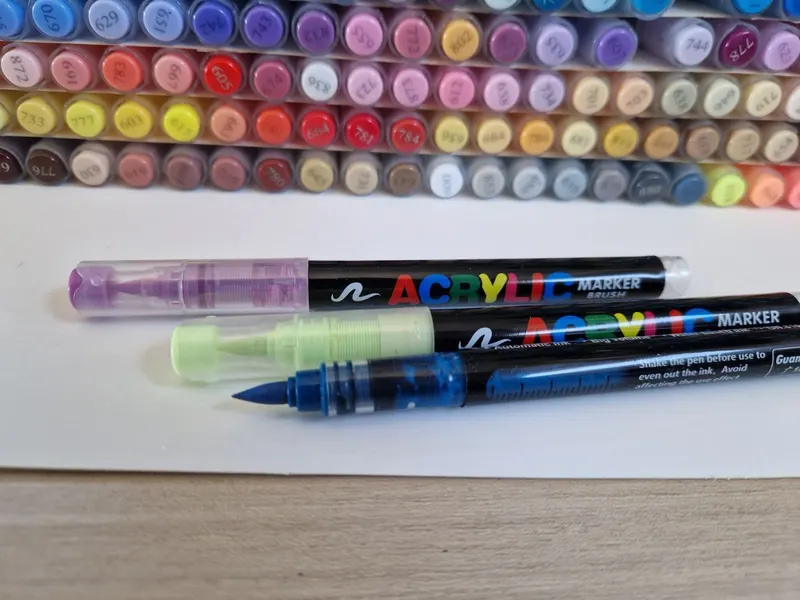
This is the best thing about the set, and it is what made me change my mind. The tip has exactly the right amount of spring. It lays down when you want to cover a surface, and it comes back straight enough to follow a tight outline without slipping.
I did the whole central lattice of my page with it, and all the small leaf shapes, without switching tools. With a tip that was too soft I would have needed a second fine liner for the edges. Not here.
Coverage depends on the color, and reds are hungry
This is the set's real weakness, and it is not uniform. On a Disney mystery coloring with a very dense grid, where the printed lines and numbers have to be hidden, here is what I found:
The reds: 4 to 5 passes
Skin tones and golds: 2 passes
So the reds are by far the least opaque. And on a page like mine, where red covers the diamond, the four triangles and all the small leaves, that adds up to a lot of time. It is worth knowing before you pick your coloring page, not after.
But there is a trade-off, and it is a big one. Layering leaves no overlap marks at all. No bright edges where passes meet, no darker patch where they cross. That is exactly where most cheap markers give themselves away, and these do not.
What that means in practice: on a mystery coloring, plan for time rather than for patience. The result will be clean, it will just take longer to get there.
A tip that applies to every brush marker
Start with the light colors, then the mid tones, and keep the black for last, in one single block.
This is not about comfort, it is mechanical: on a brush tip, dark pigment travels back up into the fibres and then bleeds onto anything that is not yet dry. With a hard conical tip the problem is much smaller. With a brush, it is real.
The test: a full page of Disney mandalas
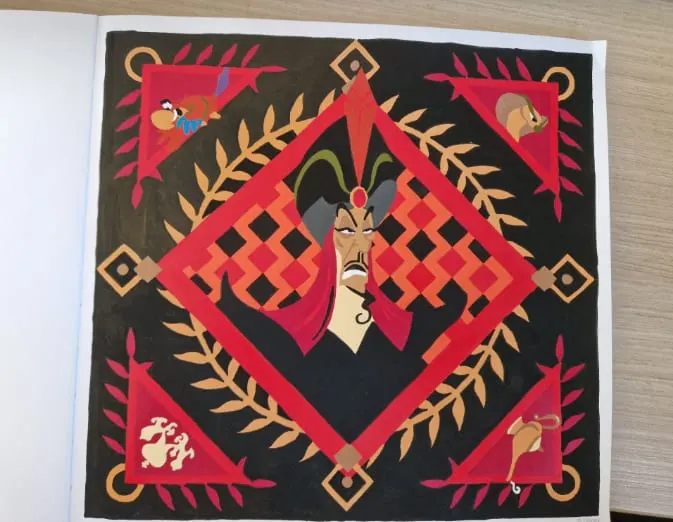
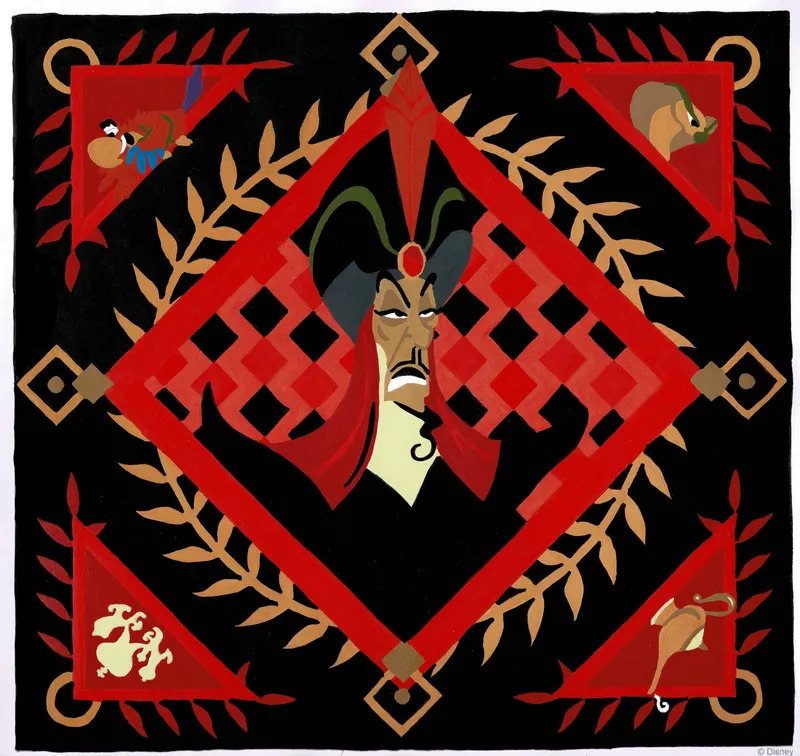
I took page 13 of the Disney Mystery Mandalas coloring book, the Jafar one. A large page, an entirely black background, a central lattice diamond, four red triangles in the corners and golden laurel branches all around. Enough to push the set on wide flat areas as well as on minuscule cutouts.
From 29 August to 26 September 2026, six to seven hours of work in total. The reds, the golds, the browns, the skin tones, the green of the turban, Jafar's whole face: all GuangNa. And it holds up very well. The three reds of the lattice stay distinct without muddying each other, and the skin tones on the face are subtle enough to give him an expression.
Fast drying, as with any acrylic. That is comfortable when you work in layers, because you can go back over an area after fifteen or twenty minutes without lifting what is underneath. And no bleed through at all, on a book that is printed on both sides.
And then there is the black
My background was about 40 percent of the page. I started with the GuangNa black, top left, around Iago's triangle. And I did not carry on.
Careful though, the problem is not the number of coats. Four passes is what this set asks for on any shade, as I just explained. The problem is elsewhere, and it is twofold.
The pigment. The GuangNa black leans olive. It is not a neutral black, it is a very dark brown green. Next to a real black it looks dirty, and no matter how far I pushed it, up to four coats, the hue did not move. No thickness corrects a pigment.
The finish. It is satin. It bounces light back. Under a lamp, while you are coloring, the area glares and you can no longer see what you are doing. And when I went to scan my finished page, it was that exact area, and only that one, that created a reflection on the scanner. I had to retouch it to get a clean image.
So I finished the remaining 40 percent of background with a black Posca. Two coats, even, matte. On the photo below, taken with no retouching at all, the difference is obvious: the top left quadrant is the GuangNa. Everything else is the Posca.
GuangNa or Posca for black
It is rare to be able to compare two brands under genuinely identical conditions. Here it is the same page, the same paper, the same day, the same hand.
GuangNa black: four coats, olive cast, satin finish
Posca black: two coats, neutral black, matte finish
On colors, the GuangNa has nothing to apologize for. On black, there is no contest.
And what about how fast they run out?
That was the question I kept asking myself along the way, and it is the one no online test covers: at four or five passes over large areas, does a marker go the distance?
The answer is yes. After a whole page and six to seven hours of work, not one marker dried out and not one is empty. The reds of the lattice, which took four to five coats over a large area, still write normally.
Who I would recommend them to
If you are starting out in mystery coloring and you want a lot of shades without spending a branded budget, then yes, honestly. Around 41 cents per marker with a tip of that quality is a good deal, and the range of colors saves you from having to mix or settle for a near enough shade.
If a floppy brush tip has disappointed you before, the Arrtx kind, do not cross the whole format off your list. These are nothing like them.
If you are in a hurry, on the other hand, look elsewhere. Four to five passes on every area changes how long a coloring takes.
And if you often color large black areas, plan for a separate black. One black Posca is enough and it will spare you a lot of coats.
One last thing on set sizes: on Amazon the unit price barely moves between them, roughly 41 to 42 cents whichever box you take. There is no real volume saving, and the 360 set actually works out slightly dearer per marker than the 168.
My verdict
I am keeping them, and I will carry on using them. The tip is the best compromise between softness and precision I have had in my hands in this format, the layering is faultless, and the shades to price ratio is hard to beat.
You just have to accept the four to five passes, and not count on their black for a large flat area.
And I am glad I was wrong. I had written that brush tips should be avoided. That was true of the ones I knew, and false as a general rule. It is the kind of thing you only find out by taking a whole coloring to the end.
The visuals (illustrations, excerpts, photos) shown on this page are used for illustration purposes and remain the property of their respective authors/publishers. Trademarks and names belong to their respective owners. Colorings and photos are by Usako unless stated otherwise. Any reproduction, distribution, or commercial reuse is not allowed without the prior consent of the rights holders.