Anti-stress coloring: does it really work?
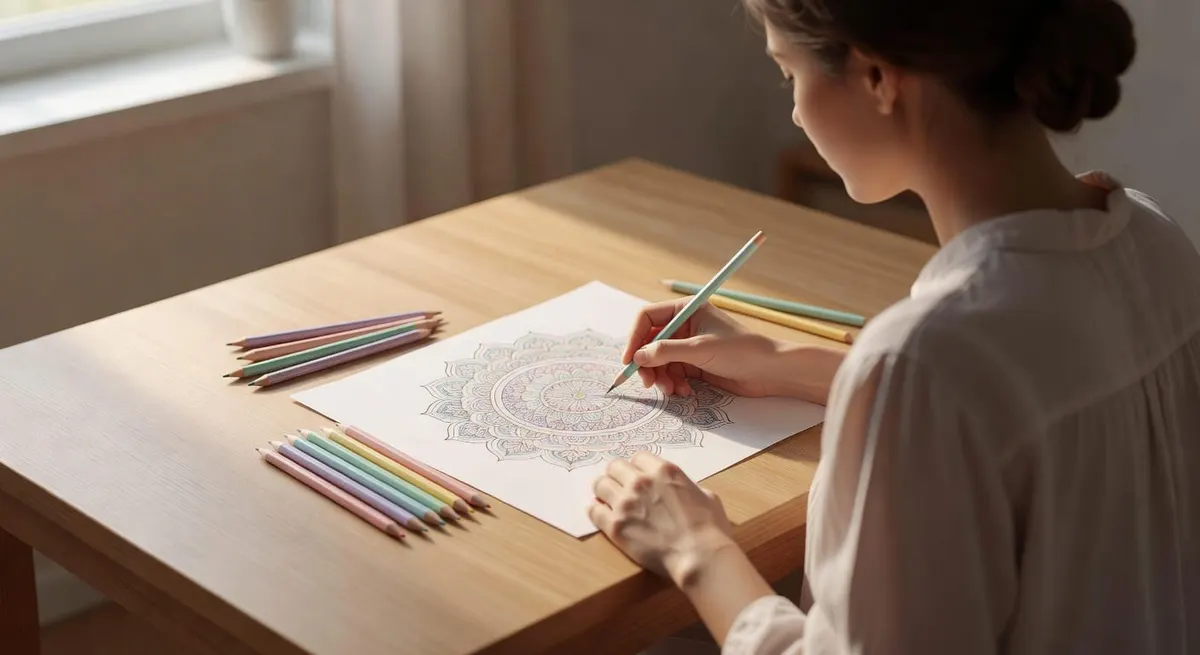
When I color to relax, I always do the same thing: I pick a drawing I know in advance I'll love the final result of. Never at random. And I always finish with the outlines, because that's the moment when the drawing really takes shape and I feel that small spark of satisfaction. Without these two things, coloring becomes a chore. With them, it's a real anti-stress tool. This article explains why it works, what science says, and most importantly how to actually do it right.
What science really says
Adult coloring as an anti-stress tool didn't appear out of nowhere. It was Carl Jung, the Swiss psychiatrist, who popularized the idea in the early 20th century by having his patients color mandalas. The idea sat dormant for decades, until researchers started looking into it in the 2000s.
The most cited study is by Nancy Curry and Tim Kasser (2005). They asked students to either color a mandala, color a geometric pattern, or doodle freely on a blank page. The result: only the mandala and geometric pattern groups saw their anxiety significantly decrease. Free doodling brought no benefit at all. The structure of the drawing matters.
Other studies have confirmed this. Research by Flett and colleagues (2017) at the University of Otago showed that one week of daily coloring significantly reduced anxiety and depression symptoms in students. Mantzios and Giannou (2018) found that coloring, when practiced mindfully, increased positive emotions.
Let's be honest: these studies are small, short, sometimes poorly controlled. They show a real but modest effect. Coloring is not a miracle treatment for anxiety. It's an emotional regulation tool, which is already a lot, but not the same thing.
Why it actually works
If coloring works, it's not by magic. There are specific psychological mechanisms that activate when you color.
1. Attentional focus. When you color, your brain concentrates on a simple, bounded task. You can't simultaneously think about your to-do list, the morning argument, or your bills. It's the same mechanism as mindfulness, but in a much more accessible version.
2. Progressive sense of accomplishment. Each completed section is a mini-victory. Your brain releases a little dopamine at each visible micro-progress. Over an hour-long session, you get hundreds of these micro-rewards. That's exactly what I feel when I finish with the outlines: at that moment, the drawing fully takes shape and the satisfaction peaks. It's called completion satisfaction, and it's a powerful antidote to feeling overwhelmed by infinite tasks.
3. Regulation through rhythm. The repetitive movement of the pencil or marker has a soothing effect similar to what we observe in knitting or walking. The autonomic nervous system slows down, heart rate drops. It's measurable.
4. Reassuring structure. Color-by-number, mandalas, and mystery colorings all share something in common: they give you a frame. You don't have to choose what to do, just execute. When you're mentally overloaded, that's exactly what your brain needs. No additional decisions, just simple action.
Choosing the right coloring matters more than you think
This is the point most articles forget, and it's the most important one to me: the choice of coloring makes all the difference between real relaxation and a disguised chore.
Personally, I never pick at random. I always look at the final result before starting, even though some would say it "spoils" the surprise. I don't care: if I know in advance I'll love the result, I'll enjoy the entire process. If I have any doubt, or worse if the subject doesn't appeal to me, it becomes a chore. And a chore relaxes nobody.
Concrete example: I don't like Winnie the Pooh. There. That's how it is. If you put a Winnie coloring in front of me, even a beautifully drawn one, I'll do it reluctantly. No anti-stress mechanism will kick in. Instead, I'll feel frustrated about investing time in something I won't like at the end.
So before starting an anti-stress coloring, really ask yourself: do I like this drawing? Will I want to finish it? Will I smile looking at the final result? If the answer is no to any of these, switch. The coloring market is huge, you'll always find something that really speaks to you.
Which types of coloring work best?
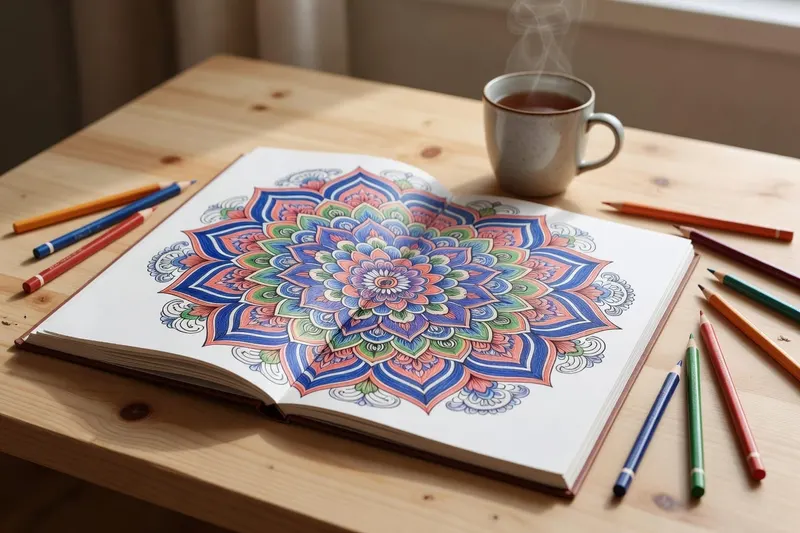
Mandalas are the most studied. Their geometric structure and symmetry have a particularly soothing effect, as Curry and Kasser's study showed.
Color-by-number (also called mystery coloring) works very well too. The advantage is that you have zero decisions to make about colors: everything is predetermined. For an overloaded brain, it's perfect.
Highly detailed colorings like "Secret Garden" can actually be stressful for some people. So many tiny zones to fill can produce completion stress. If you find yourself tense in front of a too-dense coloring, switch. The point is to relax, not to frustrate yourself.
Kawaii pixel art is my specialty on this site. The very regular grid format, cute motifs, and well-defined zones create a sense of visual safety. You can try without signing up by downloading a free printable PDF, or color directly online in the gallery.
How to start, concretely
No need for fancy materials to get started. Here's what works for most people:
- Pick a drawing you'll love finishing. Always look at the final result before committing. That's the number one tip.
- Choose a coloring that's not too complex at first. The goal is to finish, not to exhaust yourself.
- Plan at least 20 to 30 minutes. Anti-stress benefits really kick in after the first 10 minutes, when your brain has switched to focus mode.
- Find a calm spot. No stimulating music, just silence or very soft background. TV on in the background cancels out the effects.
- Avoid the pressure to finish. You can put it down, pick it up later. A coloring done over multiple sessions is not a failure.
- Keep reasonable expectations. You won't be transformed in one session. With 3 or 4 sessions a week over a few weeks, you'll feel a real difference.
What coloring won't do for you
Let's be clear: coloring isn't going to solve the cause of your stress. If your job is toxic, if you're going through a hard time, if you're carrying a mental load that's too much, coloring helps you hold on, not change the situation. It's a regulation tool, not a magic wand.
And not everyone clicks with it. Some people find it boring, frustrating, or simply not stimulating enough. That's OK. There are plenty of other techniques that work too: walking, knitting, gardening, music. What matters is finding your tool.
Conclusion: a simple tool, in its right place
Anti-stress coloring works. Science confirms it, and the experience of millions of people confirms it too. It's not a placebo, it's not a marketing fad, it's a real emotional regulation mechanism with solid foundations.
But for it to work for you, two conditions: pick a drawing you'll love finishing, and give yourself the time to switch into focus mode. The rest follows naturally.
If you want to try right now, you can download a free printable PDF coloring without signing up, or browse the online coloring gallery to find one you'll really love.
Frequently asked questions
How long does it take to feel the anti-stress effect?
Benefits typically start after 10 to 15 minutes of continuous coloring, the time it takes for your brain to switch into focus mode. A 20 to 30-minute session is ideal to feel real relaxation. Long-term, 3 to 4 sessions per week over a few weeks produce cumulative effects on daily stress levels.
Does digital coloring work as well as paper coloring?
Yes, the mechanisms are the same: focus, completion satisfaction, regulation through rhythm. Digital coloring even has a practical advantage: you can undo a color that doesn't work, which reduces frustration. Paper coloring offers a tactile feel that some people prefer. Both work.
Is coloring suitable for children to manage stress?
Yes, and it's particularly useful for children who struggle to verbalize their emotions. Coloring offers a structured frame that soothes without requiring verbal effort. For children, prefer simple drawings with large zones, and let them pick the subject themselves. The choice of drawing is even more crucial for them than for adults.
Should I pick highly detailed or simple colorings?
It depends on your current state. When you're very tired or stressed, pick simple: large zones, few colors, reasonable size. You'll finish, you'll feel satisfied, you'll feel better. Save highly detailed colorings for days when you have energy and mental availability. Forcing a too-complex coloring when exhausted is the best way to turn relaxation into frustration.